
Quick answer
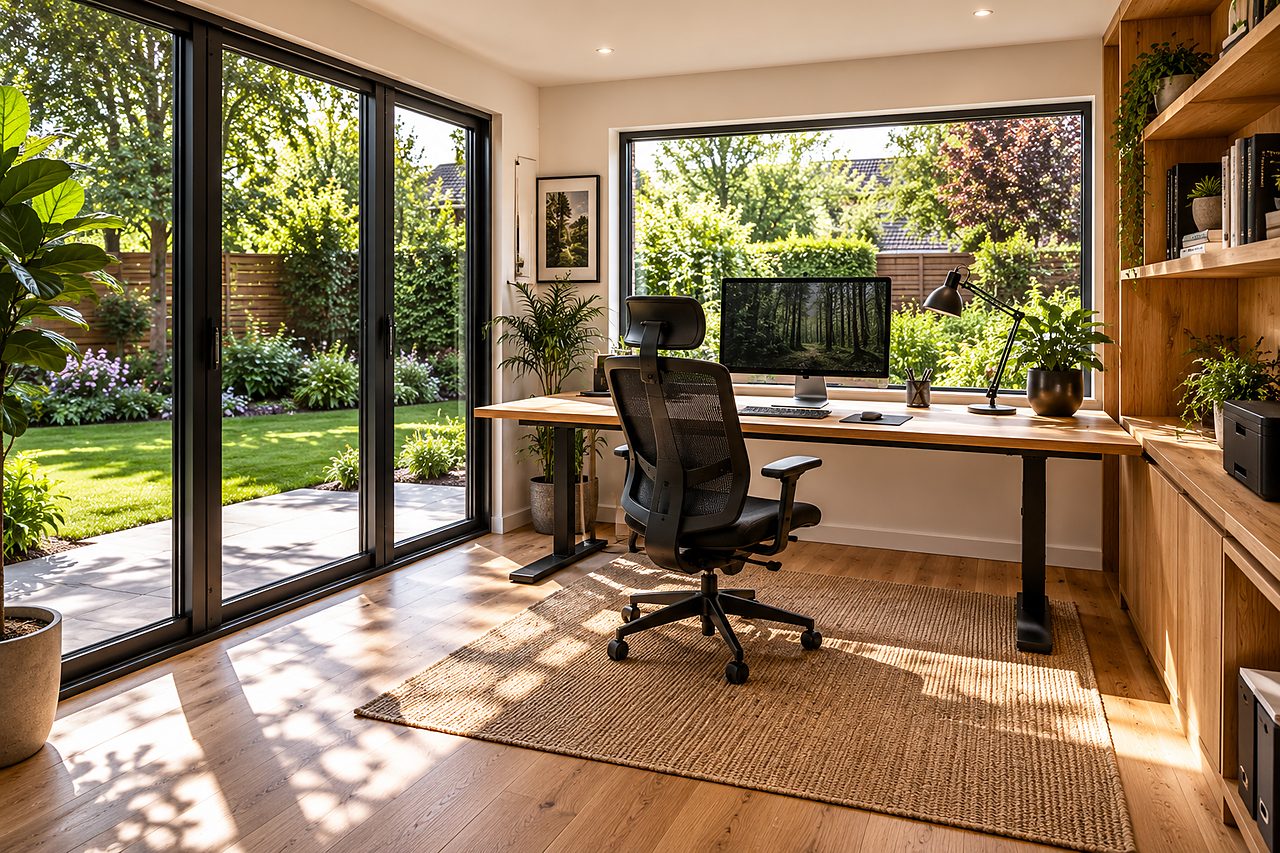
For most homeowners, a garden office costs 30–50% less than an equivalent house extension, takes weeks not months to build, and rarely needs planning permission. An extension adds more raw property value and integrates fully with the house, but disrupts daily life for months, requires planning and building regulations approval, and typically costs £2,000–£3,000 per square metre. A garden office is better for dedicated workspace or hobby use; an extension is better if you need integrated everyday living space.
Cost comparison — the honest numbers
The most useful way to compare is cost per usable square metre. A single-storey rear extension in the UK in 2026 typically costs £2,000–£3,000 per m² for a mid-spec finish, or £2,500–£4,000/m² in London and the South East. A fully-installed insulated garden room comes in at £800–£1,600 per m² for the same interior finish quality. For a 20m² space that's a spread of £40,000–£60,000 for an extension versus £16,000–£32,000 for a garden office. The extension adds more property value, but the cost-per-m² is roughly double for the same usable floor area.
Time and disruption
This is where the gap widens dramatically. A typical rear extension takes 3–5 months on site, plus 8–12 weeks for planning approval and 4–8 weeks for architectural drawings and structural engineering before you can start. That's 6–9 months of dust, scaffolding, and workmen through your kitchen. A garden office is 3–6 weeks from order to handover if no planning is needed, with all the mess kept in the garden. If you have young children, run a business from home, or can't tolerate months of disruption, this alone can decide it.
Planning permission and building regulations
House extensions almost always need both planning permission (or a formal permitted development check) and full building regulations approval. Even a modest extension involves a party wall notice if you share boundaries, structural calcs for the new opening into the house, and a building control officer visiting through the build. A garden office under 2.5m at boundaries and under 30m² typically needs neither planning permission nor building regs — a huge time and cost saving, though we'd still recommend a Lawful Development Certificate for peace of mind on future resale.
Property value uplift
This is the strongest argument for an extension. A well-executed extension typically adds 15–20% to a home's value in the UK — so a £50,000 spend on a £400,000 home can recover most of the cost through valuation. A garden office adds around 5–7% — real but smaller. For a well-built annexe with planning permission, that rises to 10–15%. If you're spending as an investment, the extension wins on return; if you're spending for lifestyle, the garden office often gives you far more usable space per pound.
Practical, everyday differences
An extension is integrated with the house — same heating system, same water, no going outside in the rain. It's ideal for kitchens, family rooms, and additional bedrooms — anything that needs to be part of the daily flow of the home. A garden office is separated, which is exactly why people love it for work. The 30-second commute across the lawn is a real mental boundary between home and work — something a spare-bedroom office never quite achieves. For gyms, music studios, therapy rooms and hobbies, the separation is a feature, not a limitation.
Which one is right for you?
Choose an extension if: you need more everyday family living space (bigger kitchen, extra bedroom, ground-floor bathroom); you're planning to sell in the next 3–5 years and want maximum value uplift; you already have a big garden and don't mind long project timelines.
Choose a garden office/room if: you specifically need dedicated workspace or hobby space; you want the project done in weeks not months; you want to avoid planning permission; your budget is under £30,000; you have moderate garden space you're happy to give up around 10–20m² of.
Choose a garden office/room if: you specifically need dedicated workspace or hobby space; you want the project done in weeks not months; you want to avoid planning permission; your budget is under £30,000; you have moderate garden space you're happy to give up around 10–20m² of.
Frequently asked questions
Which adds more value — an extension or a garden room?
An extension typically adds 15–20% to property value; a garden room adds 5–7%, or 10–15% if it's a fully-permitted annexe. Extensions win on absolute value uplift; garden rooms win on cost efficiency.
Can I use a garden office all year round?
Yes — a properly-insulated garden office (100mm+ PIR walls, double or triple glazing, decent heating) works exactly like an indoor room in every UK climate. That's the entire point of a modern garden office versus a summerhouse.
Do I need planning permission for an extension?
Some extensions qualify under permitted development (rear extensions up to 4m for detached houses, 3m for semis, subject to conditions), but most homeowners still apply for planning permission or a Certificate of Lawfulness for certainty.
Which is quicker — extension or garden office?
A garden office is 3–6 weeks from order to handover. An extension is 6–9 months including design, planning, and build. It's not close.
Can I put a bathroom in a garden office?
Yes, but it changes the classification. A garden room with plumbing and a bathroom is treated as a garden annexe by building control, which triggers full building regs and often planning permission.
Is a garden office cheaper to run than an extension?
Slightly, because it's smaller and often better insulated than an older-house extension. A well-built 15m² office costs £5–£15 a month to heat in winter. An extension shares the house's heating system so its running cost depends on the whole property.