
Quick answer
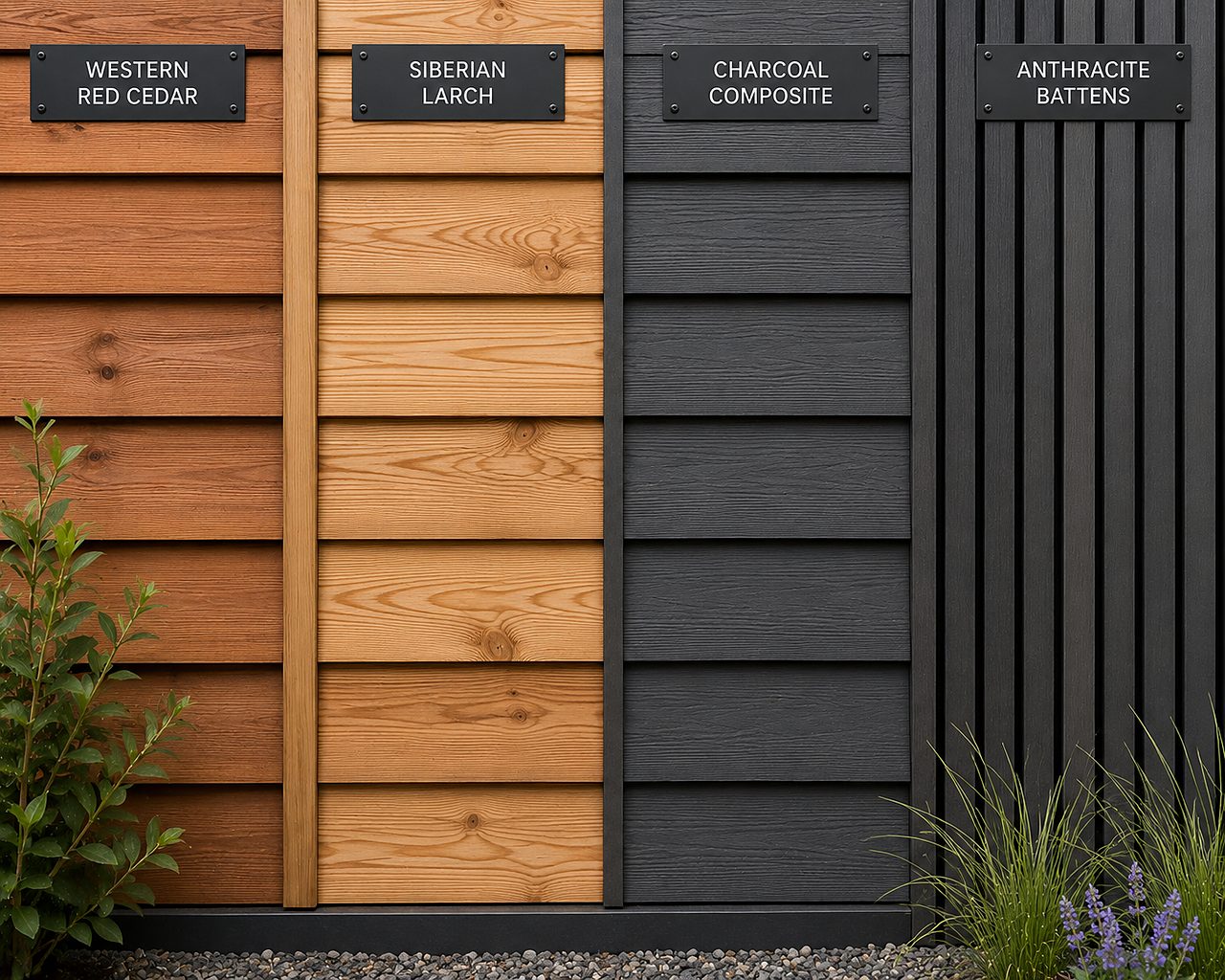
Western red cedar is the most popular premium garden room cladding — naturally rot-resistant, silvers gracefully over time, and needs minimal maintenance. Composite cladding is the most low-maintenance option with the longest warranty (typically 25 years). Siberian larch offers similar durability to cedar at a lower price point. The right choice depends on your budget, the look you want, and how much maintenance you're willing to do over 20 years.
Western red cedar
Cedar is the benchmark timber cladding for premium UK garden rooms and there's a reason for it. It contains natural oils that resist rot, insects and fungus without preservative treatment — expected lifespan is 30–40 years untreated. Left alone, it silvers to a beautiful driftwood grey over 2–3 years. Treated with UV-stabilising oil every 3–5 years, it holds a warm honey-brown tone indefinitely. It's lightweight, dimensionally stable, and takes fixings well. The downside is cost — cedar cladding is around £45–£75 per m² supplied, roughly double redwood. Also worth knowing: cedar has a small blush of tannin bleed in the first few weeks after installation which can stain lighter surfaces below it.
Siberian larch
Larch is the pragmatic alternative to cedar. It's harder and denser, so it's slightly more durable in high-wear situations, and it comes in at roughly 20–30% less than cedar (£35–£55/m² supplied). It also silvers over time but takes slightly longer than cedar to reach that even weathered look, and can show more colour variation in the first year. Thermally-modified larch (heat-treated to improve stability) is a premium version that stays dimensionally rock-steady in wet UK conditions. Larch is a strong choice if you want the natural-timber look without cedar pricing, and you don't mind slightly more variability in early weathering.
Composite cladding
Composite boards are engineered from recycled wood fibre bound with plastic. The visual: modern, flat, matte finish in fixed colours (typically charcoal, graphite, oak, walnut). The pitch: near-zero maintenance — no oiling, no silvering, no colour drift. Warranties of 25 years are standard. Fire ratings are typically Class B and better than untreated timber. Cost is comparable to cedar (£50–£85/m² supplied), sometimes higher for premium ranges like Millboard or Cladco Composite. The main downsides: it doesn't look or age like real wood, and it's much heavier than timber, which occasionally affects the substructure design.
uPVC and PVC-based cladding
uPVC cladding is the budget option — around £20–£30/m² supplied, dead easy to install, virtually zero maintenance, and available in white, grey and wood-effect finishes. It works, but it never really passes for premium — the finish can look plastic close up and colour can fade over 10–15 years, particularly on south-facing walls. For a workshop, cabin or utility building where budget matters more than kerb appeal, uPVC is a sensible choice. For a garden room that's meant to look like a considered part of your home, we'd almost always suggest timber or composite instead.
Metal cladding — standing seam, corrugated, cassette
Metal cladding — usually zinc, aluminium or coated steel in standing-seam or vertical-cassette systems — has become the go-to for contemporary architectural garden rooms. It's crisp, low-maintenance, and pairs well with timber accents on windows or entry walls. Zinc develops a soft protective patina over time and can last 60+ years; aluminium is lighter and often cheaper. Costs are the highest of any option — expect £60–£110/m² supplied, plus specialist installation. It's the right choice if the design intent is modern rather than natural.
Render — silicone, monocouche, K-Rend
Render is unusual on garden rooms but sometimes used to match a rendered main house. Modern silicone-based renders are self-cleaning, colour-fast, and last 20–30 years with no maintenance. They're applied over a mesh-backed insulation board so they add insulation performance as well as finish. Cost is comparable to composite (£55–£85/m² fully applied). The look works particularly well on contemporary boxy garden rooms where a single-colour flat facade is the design intent.
Maintenance requirements summary
Rough annual time investment over a 20-year life:
• Composite / uPVC / metal — under an hour a year (a rinse-down)
• Rendered — under an hour a year for silicone; a re-paint every 10–15 years for basic render
• Cedar or larch, left to silver — under an hour a year
• Cedar or larch, oil-maintained — a half-day every 3–5 years to clean and re-oil
If maintenance genuinely matters to you, choose composite or metal. If you love natural materials and don't mind an occasional afternoon with a paintbrush, timber wins on character.
• Composite / uPVC / metal — under an hour a year (a rinse-down)
• Rendered — under an hour a year for silicone; a re-paint every 10–15 years for basic render
• Cedar or larch, left to silver — under an hour a year
• Cedar or larch, oil-maintained — a half-day every 3–5 years to clean and re-oil
If maintenance genuinely matters to you, choose composite or metal. If you love natural materials and don't mind an occasional afternoon with a paintbrush, timber wins on character.
Frequently asked questions
What is the most popular garden room cladding in the UK?
Western red cedar is the most-specified premium cladding, with composite (particularly in charcoal and graphite finishes) closing the gap fast on new-build modern-styled garden rooms.
How long does cedar cladding last on a garden room?
Western red cedar has a natural lifespan of 30–40 years when installed correctly and left untreated. Treated cedar with regular oiling can last 40–60 years.
Does timber cladding need painting or oiling?
Not for durability — cedar and larch are naturally rot-resistant and will last decades untreated, silvering to a soft grey. Oiling every 3–5 years is purely to preserve the original warm colour.
Is composite cladding fire-resistant?
Better than untreated timber. Most quality composite systems achieve a Class B (Euroclass) fire rating, and specialist fire-rated versions (Class A) are available where required by building regulations.
What's the cheapest cladding for a garden room?
Painted redwood softwood at around £15–£25/m² supplied is the cheapest genuine cladding. uPVC is similarly priced but usually looks it.
Can I mix cladding materials on one garden room?
Absolutely — mixing materials (e.g. cedar on the front elevation with painted timber on the sides, or timber with a rendered entry wall) is one of the strongest design moves for a bespoke build. It adds cost and complexity but transforms the look.